Cart 0
Manual Hair Color Mixing vs Digital Dispenser: The Real Cost for Malaysian Salons (2026)

Most Malaysian salon owners can quote the cost of a single tube of professional colour. Far fewer can tell you what their salon actually pays per finished colour service once waste, redo time, and formula inconsistency are added in. That gap is where the real cost of manual hair color mixing lives.
This guide compares manual mixing in a bowl against a digital hair color dispenser using the lens that matters most for a salon: ringgit per service, hours per week, and clients retained. We work with Malaysian salons across the spectrum, from those still mixing manually to those who have moved to digital dispensing, and the patterns are consistent.
The hidden costs of manual hair color mixing
When you mix colour by hand, every step relies on a stylist’s eye, memory, and habit. That works fine when the stylist is highly experienced and the salon is small. It starts to leak money as soon as either of those conditions changes.
Over-mixing waste
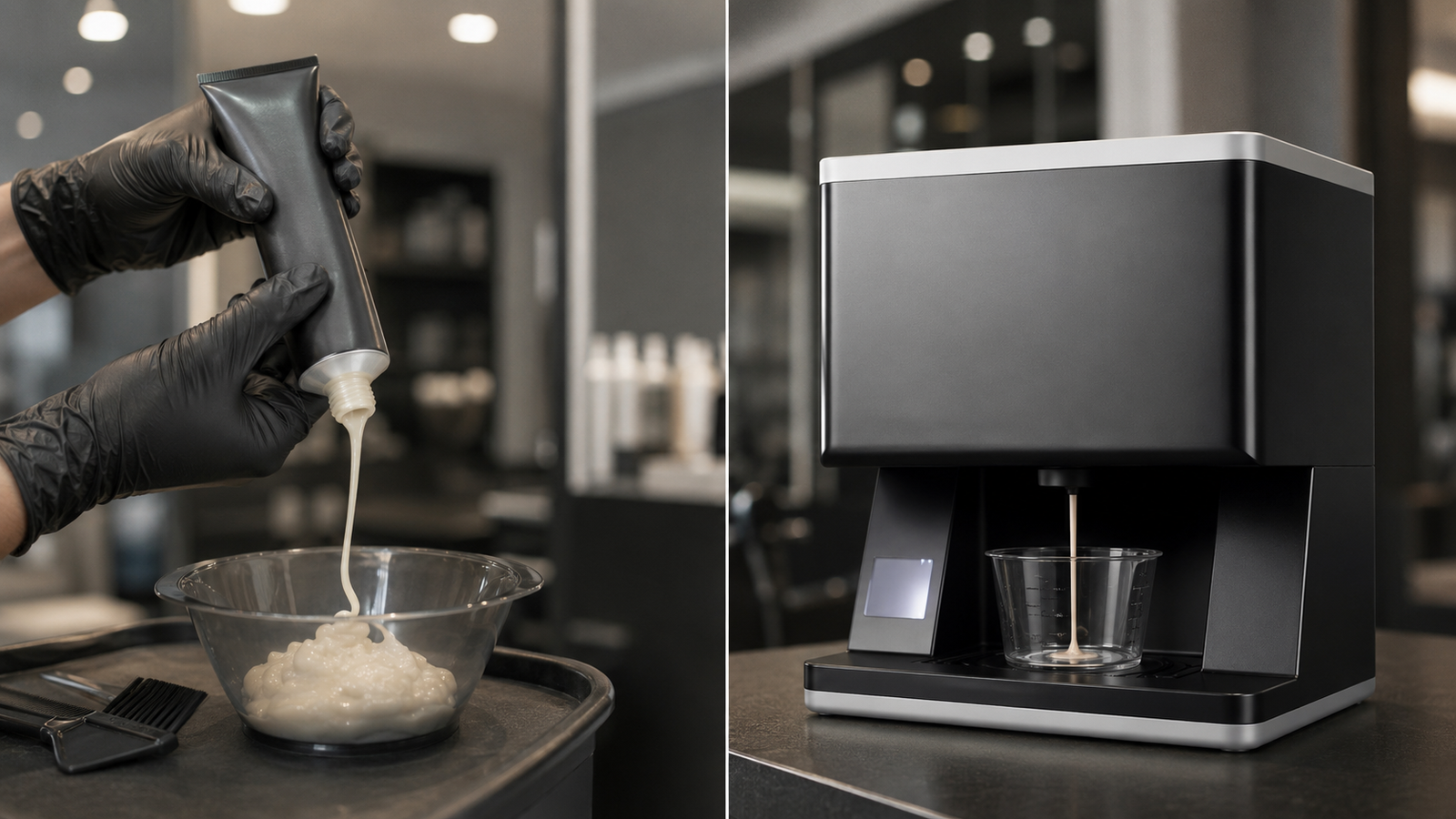
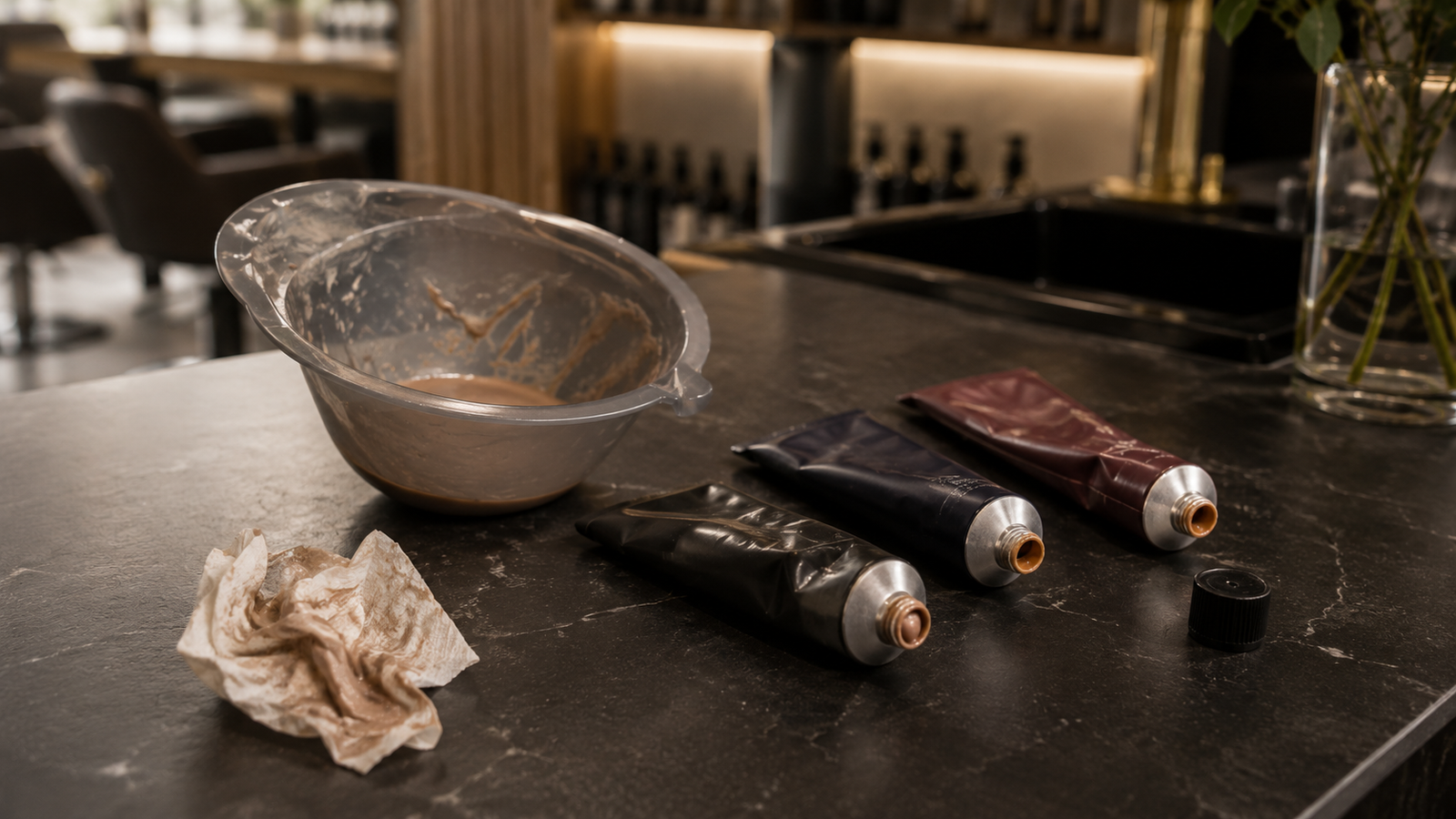
Manual mixing almost always errs on the side of “make a bit more, just in case.” We see waste rates of 20 to 30 percent in salons that mix by eye, even when stylists are experienced. On a 60ml tube of mid-tier professional colour at RM 40 to RM 70 per tube, that is RM 8 to RM 21 of product going down the sink per service, before you count developer.
Re-mix waste
When the first mix does not match the client’s intended shade, the second one has to be made from scratch. Manual salons rarely log the original ratio precisely enough to adjust by a known amount, so the redo is usually a new mix, not a correction. Every redo doubles the product cost of that service and adds 8 to 15 minutes to the chair time.
Tube spoilage
Tubes sit on the shelf. Some get opened, used once, capped, and forgotten. When a stylist reaches for them three months later, the colour has oxidised. The tube either gets used and produces an off-shade result, or gets thrown out. In a busy salon with 30 plus active shades, this category alone can quietly drain RM 200 to RM 500 a month.
Formula drift between stylists
This is the cost salon owners feel last but pay for most. Two stylists working the same client over time will deliver visibly different results unless every formula is recorded to the gram. Manual recording (handwritten notes, spreadsheets, photos on a phone) catches the broad strokes but loses the precision. Six months in, the client tells you “my colour looks different now” and books a redo, or walks.
For the waste angle specifically, we wrote a deeper analysis on how much hair color waste costs Malaysian salons every month.
Training time
A new stylist mixing manually needs months of supervised practice to deliver consistent results. During that window they are either slower than the senior stylists or producing variable colour that the salon owner has to quietly redo for clients. Both have real costs.
What a digital hair color dispenser actually changes
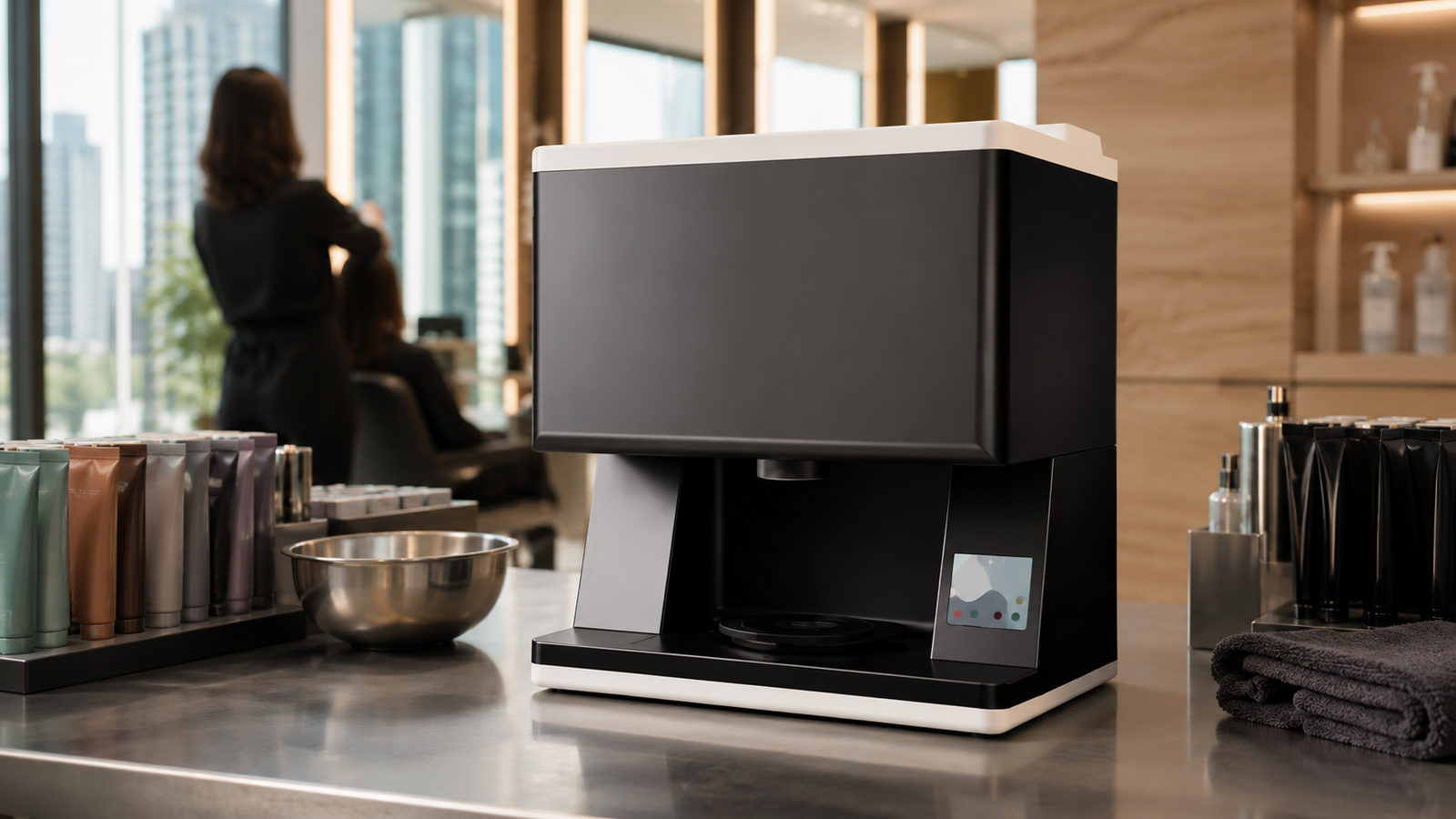
A digital hair color dispenser is not magic. It does one thing very well: it measures and dispenses colour to a precise formula every time. That single change unlocks several downstream effects.
Precision to the gram
The machine dispenses exact quantities based on a formula stored in software. A 1:1.5 mix of L’Oréal Majirel happens the same way every time, regardless of which stylist is operating it. There is no over-mixing because the formula calls for exactly what the service needs.
Formula recall by client
Once a client’s formula is stored, any stylist in the salon can deliver the same colour next visit. The new junior stylist produces the same result as the senior colourist because they are running the same formula through the same machine.
Less training, faster onboarding
Stylists do not need to master ratio math by feel. They need to understand application, sectioning, and timing, which they were going to learn anyway. The mixing skill that used to take months is now reduced to selecting the correct formula and starting the machine.
Faster setup per service
A mix that takes 4 to 6 minutes to weigh and prepare manually takes under a minute on a dispenser. For a busy salon doing 8 to 12 colour services a day, that adds up to 40 minutes or more of saved chair time daily.
Inventory clarity
Because every dispense is logged, the machine tells you exactly how much of each colour you actually used last month. Stock orders become predictable. Slow-moving shades become visible.
The cost comparison: your numbers in 2 minutes
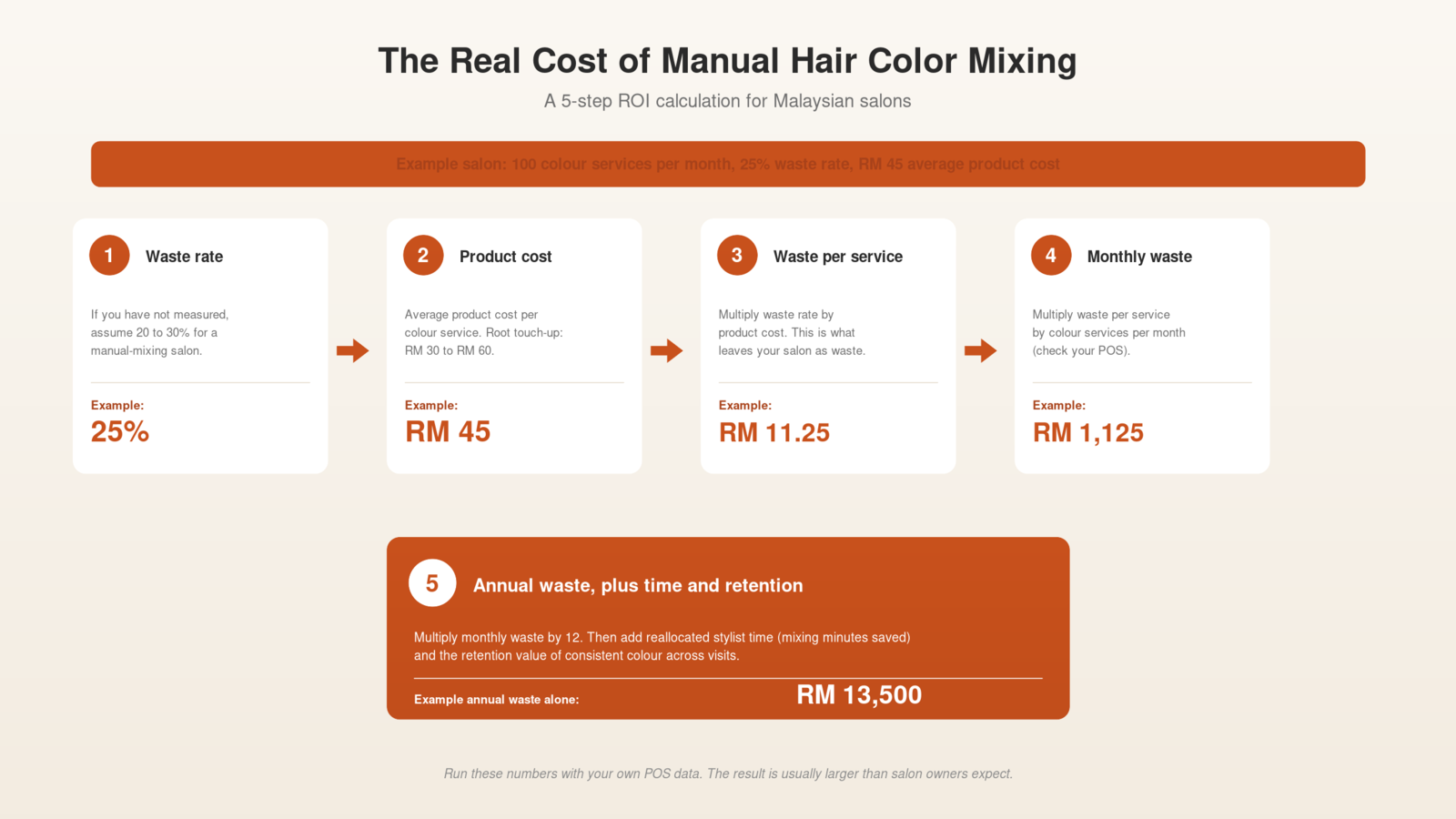
This is the calculation worth doing yourself, with your own numbers. Open your point of sale, count last month’s colour services, and walk through this:
Step 1: Estimate your current waste rate
If you have never measured, assume 20 to 30 percent for a manually-mixed salon. The truthful answer is usually closer to 30 than 20, but use what feels honest.
Step 2: Estimate your average product cost per service
A typical mid-tier colour service in Malaysia uses 60ml to 120ml of colour at RM 40 to RM 70 per 60ml tube, plus developer. For a standard root touch-up, the product cost runs RM 30 to RM 60 retail-equivalent. For a full colour or balayage, RM 60 to RM 150 plus.
Step 3: Apply the waste rate
If your average product cost is RM 45 per service and your waste rate is 25 percent, you are paying RM 11.25 per service for product that never reaches the client’s hair.
Step 4: Multiply by monthly services
A salon doing 100 colour services a month at RM 11.25 wasted per service is paying RM 1,125 a month in pure colour waste. Over 12 months that is RM 13,500 that leaves the salon as wet bowls and expired tubes.
Step 5: Add time and retention costs
If digital dispensing saves your team 30 minutes per day in mixing time, that is several extra hours of stylist time per week you can reallocate to revenue-generating services or save in payroll. Either reading is material.
If digital consistency reduces your “colour looks different” redo rate by even 1 in 50 services, you have saved your team multiple hours of unpaid redo work plus the client trust that is much harder to rebuild.
This is the real number worth running before any conversation about machine pricing.
When manual mixing still makes sense
Digital dispensing is not the right answer for every salon. Manual mixing remains the better choice when:
- You are a single colourist working alone. Formula drift is not a problem when one person mixes every service. The investment case for a machine weakens significantly.
- Your colour menu is small and infrequent. Salons that do five colour services a week, mostly root touch-ups in the same shade family, do not generate enough waste to make the math work.
- Your work is heavily artistic. Free-form balayage, hand-painted colour, and experimental fashion shades sometimes benefit from the flexibility of mixing by hand and adjusting in real time. A skilled colourist with this kind of work flow can outperform a machine on highly custom services.
If two or more of these describe your salon, do not let anyone (including us) talk you into a machine you will not use to its full potential.
When digital mixing makes sense
Digital dispensing pays back fastest when:
- You have 2 or more colourists working from shared client records. Consistency between stylists is the single biggest lift the machine delivers.
- You run 30 or more colour services a week. Volume is what makes the per-service waste reduction add up to meaningful money.
- Your clientele expects consistent results. Premium positioning, corporate clientele, repeat clients who want their “regular colour” every visit. These segments quietly leave when results drift.
- You are scaling or training new colourists. A new stylist can be productive on the colour bar in weeks rather than months when the mixing skill is handled by the machine.
We wrote a detailed guide on how to keep hair colour consistent across stylists in your salon if you want the full process framework around digital mixing.
The cost that does not show on the spreadsheet: retention
Salon owners undercount this one. A client who has been visiting your salon for two years pays for far more than a one-off walk-in. If your colour consistency slips, they often do not complain. They just stop booking.
We have seen Malaysian salons reduce their “colour drift” complaints to near zero within three months of switching to digital dispensing, simply because every visit produces the same shade. The retention lift is not always visible on the P&L line for “colour services” but it shows up in lifetime client value.
If even one of your 100 monthly clients stays an extra year because of consistent colour, the lifetime value alone (depending on your salon’s pricing and visit frequency) is often RM 2,000 to RM 5,000. Across a full client base, the retention math typically exceeds the waste math.
Quick reference: which path fits your salon?
| Salon profile | Best fit |
|---|---|
| Solo stylist, low colour volume | Manual mixing |
| 2 plus stylists, 30 plus colour services per week | Digital dispenser |
| Heavy fashion/artistic work, mostly custom | Manual or hybrid |
| Premium positioning, repeat clients, brand consistency | Digital dispenser |
| Scaling, training new colourists | Digital dispenser |
| Single-shade root touch-ups dominate | Manual mixing |
If your salon sits in the middle of these, the deciding factor is usually growth. Salons planning to grow past 2 colourists or 30 services a week tend to be better served by switching before the consistency problem becomes a retention problem.
Frequently asked questions
How much does a digital hair color dispenser cost in Malaysia?
Pricing varies by brand and feature set. Entry-level machines start around RM 1,500 for a basic model and climb meaningfully for systems with full software, multi-formula storage, and integration with salon management tools. The BeHairppy 5G Hair Color Machine is positioned at the value end of the professional range, starting from RM 1,500. See the product page for current specifications and feature details.
How long does payback take?
For a salon doing 100 colour services a month with a 25 percent waste rate, monthly waste savings of RM 800 to RM 1,200 are typical. That puts payback for a mid-tier dispenser within 6 to 18 months for most salons. Higher-volume salons recover the investment faster.
Does a digital dispenser work with all professional hair color brands?
Most digital dispensers support the major professional brands (Wella Koleston Perfect, L’Oréal Majirel, Schwarzkopf Igora, Pravana ChromaSilk and several others), though specific brand compatibility depends on the machine. Different brands use different mixing ratios (1:1, 1:1.5, 1:2) and the machine should support yours. For a brand-by-brand breakdown of mixing systems, see our guide to professional hair color brands for Malaysian salons.
What is the learning curve for stylists?
Most stylists are operational on a digital dispenser within a single shift. The interface is straightforward: select formula, dispense, apply. The harder transition is cultural, getting senior colourists comfortable with letting the machine handle a step they used to take pride in. Salons that introduce the machine as a tool that frees the colourist to focus on application and finish, rather than a replacement for their craft, see faster adoption.
Will my stylists resist switching to a machine?
Some will. The resistance usually fades once they see the time savings and the cleaner results. Stylists who took pride in mixing accuracy often become the strongest advocates because the machine validates the precision they were always trying to achieve.
Can I keep manual mixing for some services and use the machine for others?
Yes. Many salons run a hybrid model where the machine handles standard root touch-ups, single-shade colour, and recurring client formulas, while artistic balayage and fashion work continues to be hand-mixed. This is often the smoothest transition path.
Bottom line
Manual hair color mixing costs Malaysian salons more than the tube price suggests. Add up waste (20 to 30 percent), redo time, formula drift, training months, and the slow client retention bleed, and the real per-service cost is often double the line-item product cost.
Digital dispensing is not the right answer for solo stylists or low-volume specialty salons. For everyone else (2 plus colourists, 30 plus weekly colour services, premium positioning, scaling teams), the math tips quickly. The waste savings alone usually cover the machine inside 18 months, and the retention gains stack on top.
If you want to see the BeHairppy 5G digital hair color mixer in action with your own colour brand, book a quick demo and bring your current formula sheet. We will walk through how it would fit your salon’s specific workflow.